
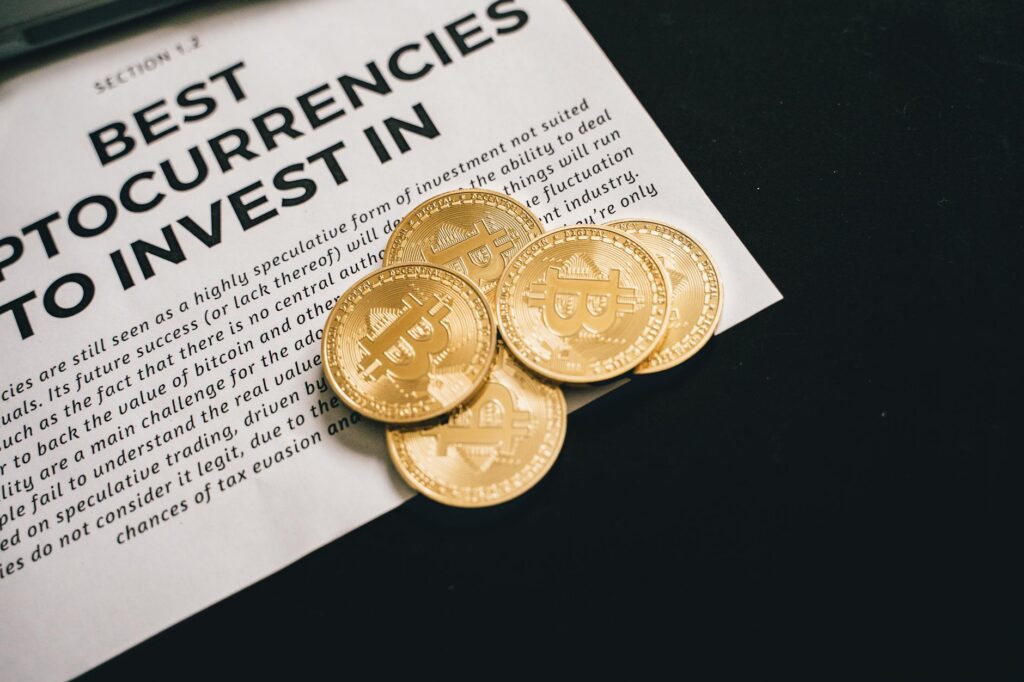
Cryptocurrency is one of the most talked-about investment categories of the past decade — and one of the most misunderstood. It’s been through multiple boom-and-bust cycles, produced enormous gains for some people and significant losses for others, and generated a volume of noise that makes it genuinely difficult to separate the useful information from the hype.
This is a practical, honest look at what crypto actually is, what the real risks are, how to approach it if you decide to invest, and what to avoid.
1. What cryptocurrency actually is
Cryptocurrency is digital money that runs on a blockchain — a decentralised, publicly verifiable ledger maintained by a distributed network of computers rather than a central authority like a bank or government.
Bitcoin, created in 2009, was the first and remains the largest by market capitalisation. Ethereum, the second largest, is a programmable blockchain that enables smart contracts — self-executing code that powers most of the decentralised finance and NFT ecosystem.
Beyond Bitcoin and Ethereum, there are thousands of other cryptocurrencies (“altcoins”). The vast majority have no meaningful use case, minimal liquidity, and are either speculative or outright scams. The distinction between the major, established assets and the long tail of low-cap coins is important.
2. What makes crypto different from traditional investments
Traditional investments like stocks or bonds have underlying fundamentals: company earnings, interest payments, economic activity. Their value is connected to something real, even if markets periodically misprice it.
Cryptocurrency is different. Bitcoin’s value comes primarily from its fixed supply (21 million coins) and network effect — the belief that others will accept it and that its scarcity has value. Ethereum has more utility value because its network powers real applications. But neither generates earnings or pays dividends in the traditional sense.
This doesn’t mean crypto has no value — it means that valuing it is genuinely harder than valuing a company with earnings and assets. The price is more directly a function of sentiment, adoption trends, and narrative than a discounted cash flow model.

3. The real risk profile
Crypto is one of the most volatile asset classes available to retail investors. Bitcoin has fallen more than 50% from its peak multiple times in its history, including drops of 80%+ in extended bear markets. Smaller cryptocurrencies have fallen by 90–99% and never recovered.
The key things to know before putting any money in:
Volatility is extreme. A 30–40% swing in weeks is a normal occurrence in crypto markets. If you’d find a 40% loss on your investment genuinely distressing, sizing your position appropriately matters more than in most asset classes.
It’s largely unregulated. In most jurisdictions, crypto exchanges and assets don’t have the same investor protections as regulated financial products. If an exchange collapses (as FTX did in 2022), or if you lose access to your holdings, recovery routes are limited.
It’s liquid but the liquidity can dry up. You can usually sell Bitcoin or Ethereum at any time during market hours. Smaller coins may have low trading volume that makes large positions difficult to exit without significantly moving the price.
Tax treatment in both the US and UK. In the UK, HMRC treats cryptocurrency as a capital asset. Selling crypto, exchanging one crypto for another, or using it to buy goods triggers a capital gains event. The annual CGT allowance (£3,000 in 2024/25) covers modest gains; gains above that are taxed at 18% or 24% for UK taxpayers. In the US, the IRS treats crypto similarly — it’s a capital asset, and every disposal is a taxable event. Short-term gains (held under a year) are taxed as ordinary income; long-term gains at lower capital gains rates.
4. How to buy crypto safely
The practical route for most people is a regulated exchange — a platform where you deposit fiat currency (pounds or dollars) and buy crypto in return.
In the UK, exchanges must register with the FCA for anti-money laundering purposes. The FCA maintains a register of registered and unregistered entities. In the US, major exchanges operate under FinCEN money services business requirements, with some states requiring additional licences.
Use a reputable, regulated exchange. Major platforms with long operating histories are significantly lower risk than lesser-known alternatives. The collapse of FTX in 2022 — once a top-three exchange globally — demonstrated that “large” doesn’t guarantee safe, but track record and regulatory oversight are still meaningful filters.
Don’t leave large amounts on exchanges. Exchanges have been hacked and have collapsed. For amounts you’re not actively trading, a hardware wallet — a physical device that stores your private keys offline — provides substantially better security. The trade-off is that losing access to a hardware wallet (losing the seed phrase) means losing the crypto permanently.
Start small. If you’re new to crypto, buying a small amount to understand how wallets, keys, and transactions actually work is worthwhile before putting in anything meaningful.
5. How much to allocate
Crypto should be treated as a speculative, high-risk allocation within a broader portfolio — not as a substitute for it. A commonly cited approach: limit crypto to 5–10% of investable assets, sized so that losing the entire position would be painful but not financially devastating.
For most young investors, the priority order should be:
- Emergency fund (3–6 months expenses)
- High-rate debt cleared
- Core investment portfolio (index funds, pension/ISA/401k)
- Any speculative allocations including crypto
Investing in crypto before having an emergency fund or before making pension contributions is taking on speculative risk before the foundations are in place.
6. Bitcoin vs Ethereum vs altcoins
If you’re going to invest in crypto, Bitcoin and Ethereum have the clearest case as investable assets: the longest track records, the deepest liquidity, and the strongest network effects.
Bitcoin is primarily a store-of-value play — a scarce digital asset that some investors treat as “digital gold.” Its total supply is fixed at 21 million coins, which creates a hard scarcity that no central authority can override.
Ethereum is a programmable blockchain — a platform that enables decentralised applications. Its value is tied to the utility and growth of its network. It’s more complex than Bitcoin and comes with different risk factors, including competition from other smart contract platforms.
Altcoins — anything beyond the top few by market cap — are materially more speculative. Many have launched with genuine use cases; the majority have failed. The ones that haven’t failed are still typically much less liquid and much more volatile than Bitcoin or Ethereum.
7. What to avoid
Meme coins. Dogecoin, Shiba Inu, and the dozens of similar coins that have launched on the back of internet culture have no meaningful use case. They’re purely speculative instruments that have made some people money and caused significant losses for many more.
Yield farming and DeFi platforms offering unusually high returns. Annual percentage yields of 20%+, sometimes 100%+ in DeFi protocols, are almost always either temporary, unsustainable, or involve significant hidden risk. Many have collapsed, taking user funds with them.
Crypto “investment” advice on social media. Paid promoters, influencer shills, and anonymous tip accounts are endemic in crypto. If someone is publicly promoting a specific coin, the financial incentive to do so should be assumed.
Putting in more than you can afford to lose. This is a cliché for a reason. Crypto markets have inflicted significant financial damage on people who put in money they needed for other things.
The honest summary
Crypto is a legitimate asset class with a real track record — both of significant gains and significant losses. For investors who understand the risks, want exposure, and are allocating a small portion of an otherwise diversified portfolio, it’s a reasonable choice.
For investors who don’t have an emergency fund, are carrying high-rate debt, or are considering crypto as a primary investment rather than a supplementary one, the priority order is worth reconsidering first.
If you’re building the core portfolio first, index fund investing for beginners is where most of the long-term wealth-building actually happens.